Most businesses that hire the wrong agency lose three to six months of budget before they figure it out. The problem usually isn’t the services offered. It’s that the business didn’t know what a digital marketing agency was actually supposed to deliver in the first place, so they had no way to evaluate whether they were getting it.
This article cuts through the sales pitches. By the end, you’ll know what these agencies do, what they cost in 2026, what separates a strong partner from a risky one, and how to verify what any digital marketing company is actually capable of before you hand over a retainer check. Agencies like WaysPro Tech operate on an integrated model, SEO, paid ads, content, and web development under one roof and one strategy, and this article explains exactly why that structure produces better outcomes than the alternative. We’ll cover services, evaluation questions, red flags, case study verification, and pricing benchmarks.
What a digital marketing agency actually does
Not all agencies offer the same scope, and that distinction matters more than most business owners realize. Some firms are channel specialists handling only SEO or only paid advertising. Others are full-service marketing agencies managing multiple channels simultaneously. The difference directly affects your strategy’s cohesion and how much coordination work lands back on your team.
The core services a full-service agency handles
A full-service online marketing agency typically covers four pillars. SEO builds your organic visibility so qualified buyers find you through search without a paid click. PPC and paid advertising drives targeted traffic through Google Ads, Meta, and display channels, with results tied to ROAS and CPA. Content marketing, including blogs, landing pages, and email, builds authority and gives SEO the fuel it needs to rank. Web design and development ensures your site converts the traffic all those other channels send its way.
Each pillar drives a specific business outcome, not just activity. Organic search reduces long-term acquisition costs. Paid channels deliver faster leads with more control over spend. Content compounds over time. And a well-built site turns visitors into customers instead of letting them bounce.
How these services connect to each other
SEO needs content to rank, and that content needs strong web design to convert the readers it attracts. Without fast-loading, intent-matched landing pages, PPC spend leaks regardless of how well the ad itself performs. When each of those services is managed by a different vendor, the chain breaks constantly. When one web marketing firm owns all of it, the strategy compounds instead of fragmenting.
How to choose a digital marketing agency: integrated vs. multiple vendors
Managing three separate specialists is expensive in ways that don’t show up on any invoice. You’re paying for separate onboarding timelines, billing cycles, and reporting dashboards across three teams that will almost never talk to each other. When results stall, there’s no single point of accountability. Each vendor points at the others, and you’re stuck in the middle trying to diagnose a problem that spans all three.
The real cost of managing multiple specialists
The coordination tax is real. Your SEO agency doesn’t know what your PPC agency is bidding on, so they’re often duplicating keyword research or pulling in opposite directions. Your content team doesn’t know which landing pages are underperforming in paid campaigns, so they’re not writing to fix the right problems. Fragmented strategy means duplicated effort, missed opportunities, and reports that look healthy individually but don’t add up to revenue growth.
What a single-agency approach looks like in practice
WaysPro Tech manages SEO, paid ads, content, and web development under one roof, which means the SEO team and the PPC team are sharing keyword data in real time. The content team writes to support both channels, not just one. The developer optimizes pages based on actual conversion data rather than aesthetics alone. That’s how integrated strategy actually works, and it’s why WaysPro Tech holds a 91% client retention rate. Clients stay because the model delivers results that fragmented vendor arrangements rarely match.
Questions to ask a digital marketing agency before you sign anything
Experienced CMOs and procurement teams come to discovery calls with a specific set of questions, and you should borrow their playbook. The goal is to separate agencies that talk about results from agencies that can demonstrate them.
Strategy and accountability questions
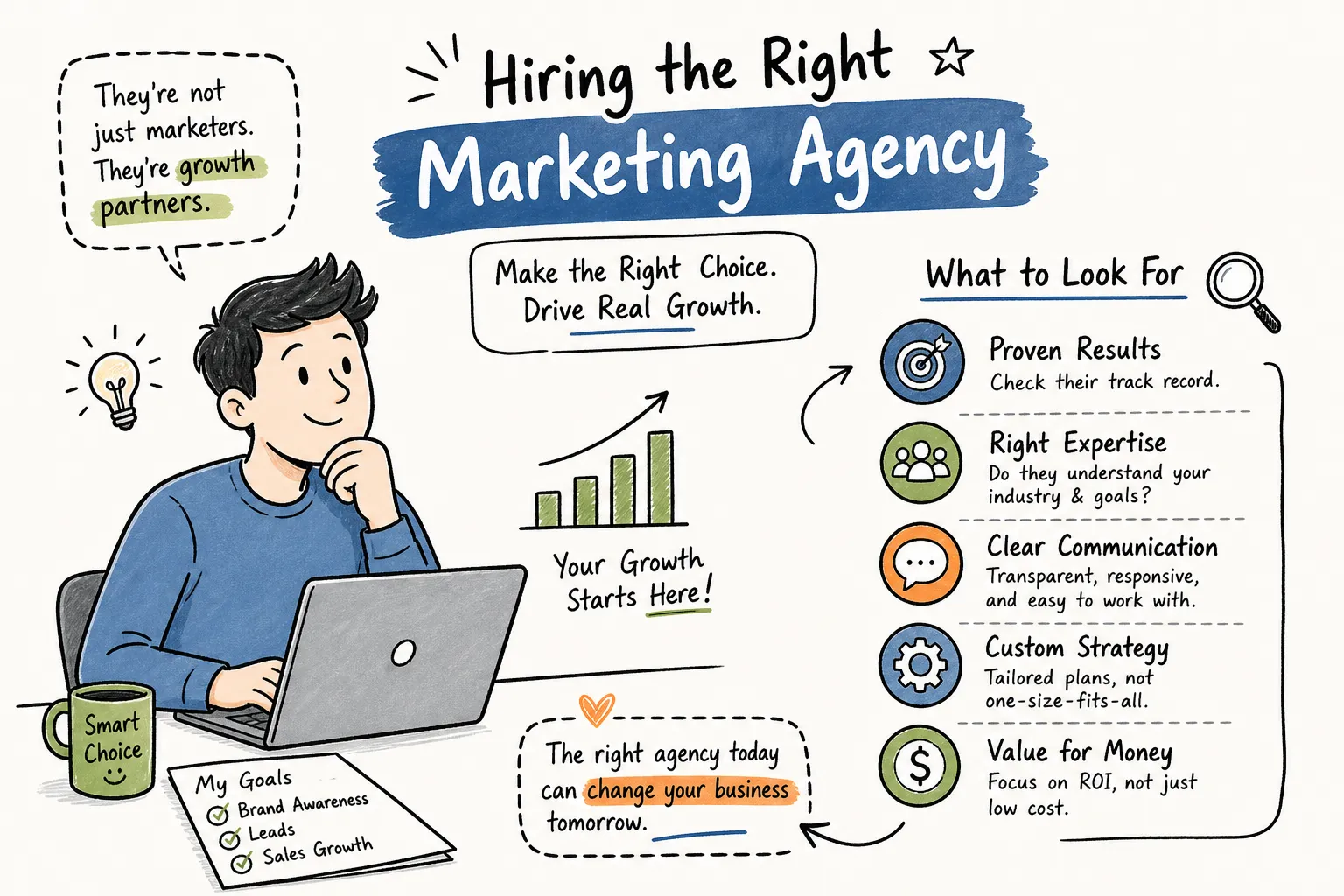
Ask what specific business result the engagement will drive and how the agency will measure it. The 90-day versus month-six distinction matters because those are fundamentally different performance targets, make sure you get specifics on both. Ask how they handle underperformance. A strong marketing consultancy answers these questions with specifics: a target CPL, a projected traffic growth range, a defined reporting cadence. A weak one gives you vague language about “increasing visibility” and “driving awareness” without tying any of it to revenue or leads.
Team, process, and ownership questions
Find out who will actually do the work, not just who’s presenting on the sales call. Ask how stable the team is and whether you’ll have a consistent account manager or get rotated through junior staff. Most importantly, clarify who owns the assets when the contract ends. Your ad accounts, analytics properties, content files, and website should always belong to you. If an agency is evasive about team structure or asset ownership before you sign, that tells you everything you need to know about how they’ll behave afterward.
Red flags that reveal a risky agency
The agencies that look best on a sales call are sometimes the ones that underdeliver the most consistently after onboarding. Knowing what to watch for before you commit saves you the three-to-six-month loss mentioned at the start of this article.
Promises no credible performance marketing firm should make
Walk away from any agency that guarantees a specific ranking position within a fixed timeframe. Phrases like “top 3 in 30 days” or “page one guaranteed” are not ambitious targets. They’re warning signs. Reputable agencies give ranges and realistic timeframes with clear caveats about competition, starting domain authority, and content gaps. Google’s algorithm is not something any agency can negotiate with, and the ones claiming otherwise are either misinformed or deliberately misleading you.
Reporting and transparency warning signs
Bad reporting looks like a monthly PDF full of keyword rankings and impressions with no leads, revenue, or pipeline data anywhere in it. A legitimate digital advertising agency connects activity to outcomes. If you can’t see how last month’s work affected your cost per lead or your sales pipeline, you’re not being given the information you need to make good decisions. Also pay close attention to account access: an agency that won’t give you direct access to your own Google Search Console, analytics, or ad accounts is a structural problem, not a minor inconvenience. If you can’t verify the numbers yourself, the numbers can say anything.
How to read an agency’s case studies without being misled
Case studies are starting evidence, not proof. Treat them as a framework for asking better questions rather than as confirmation that the agency delivers. The difference between a credible case study and marketing copy comes down to a few specific elements.
What the numbers actually need to show
A credible case study includes a baseline (where the client started), a timeframe (how long it took), and a business-level outcome such as revenue, leads, or booked appointments. Traffic spikes and ranking improvements aren’t business outcomes unless they connect to something a CFO would care about. Also examine the attribution: if a brand was running PPC, social ads, and SEO simultaneously, crediting all growth to one channel is misleading by design.
Proof you should always request
Ask for a live analytics walkthrough or dashboard access instead of screenshots. Screenshots can be edited; live data can’t. Request a reference call with the featured client and come prepared with specific questions about the starting point, the timeline, and whether results held after the initial campaign. Use tools like Ahrefs or SEMrush to cross-check organic traffic claims independently. If an agency can’t show at least one verifiable, dated example with a checkable baseline and a real outcome, treat the case study as marketing copy. That standard isn’t harsh; it’s the minimum bar for any vendor you’re trusting with your growth budget.
What a digital marketing agency costs and what ROI looks like in real terms
Pricing varies by scope and channel, but 2026 benchmarks give you a solid baseline for evaluating proposals and spotting bids that are either suspiciously cheap or unjustifiably inflated.
Typical monthly pricing by service in 2026
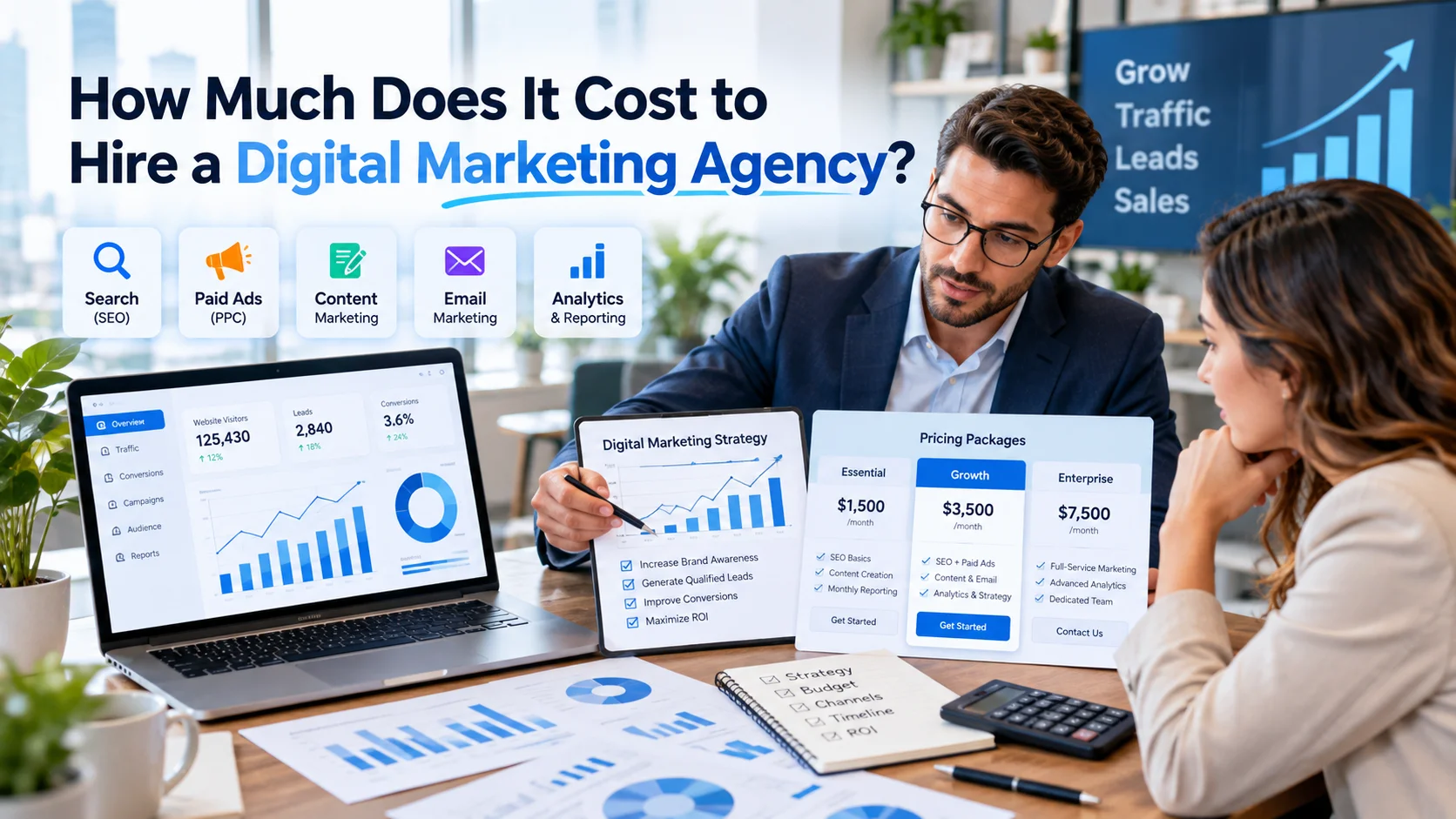
SEO retainers for most US businesses run $1,500 to $7,500 per month, with local and entry-level work at the lower end and national competitive programs at the higher end. PPC management adds $1,500 to $6,000 on top of your media budget, or roughly 10 to 20 percent of ad spend depending on the agency’s model. Social media management falls between $1,000 and $5,000 per month when it includes creative production and paid social. Full-service, multi-channel retainers generally start around $5,000 and scale to $25,000 or more for mid-market and enterprise programs. Those ranges reflect real scope differences, not arbitrary pricing.
KPIs that connect your spend to business outcomes
The metrics worth tracking are ROI, cost per lead or acquisition, conversion rate, and pipeline influenced. Organic traffic and keyword rankings are useful leading indicators, but they’re not the finish line. Well-structured B2B SEO programs can deliver strong long-term ROI, WaysPro Tech clients in competitive verticals have benchmarked returns exceeding 600% over sustained 18-to-24-month engagements. For PPC, the focus shifts to ROAS and CPA efficiency because paid channels are judged on conversion performance, not long-term compounding. Any SEO and PPC agency worth retaining should be able to tie monthly spend to those outcome metrics clearly, not just hand you a traffic report and call it a win.
The right digital marketing agency partnership changes the trajectory
Hiring a digital marketing agency isn’t complicated once you understand what they’re supposed to do, what healthy pricing looks like, and what separates a strong partner from a risky one. The evaluation framework in this article gives you the questions to ask, the red flags to recognize, and the verification steps to run before you commit to anything.
The most common mistake businesses make is skipping the evaluation entirely and choosing based on price alone or going with whoever ranked first in their own Google search. Neither of those criteria predicts results. The questions, case study checks, and reporting standards covered here exist to prevent exactly that.
For businesses that want a single integrated partner managing SEO, paid ads, web development, and content without juggling multiple vendors, WaysPro Tech is built for exactly that model. One strategy, one team, one point of accountability, and a 91% client retention rate that reflects what that actually means in practice. If you’re ready to move forward, reach out to the WaysPro Tech team to book a consultation and see what an integrated 360 approach looks like applied to your specific business.