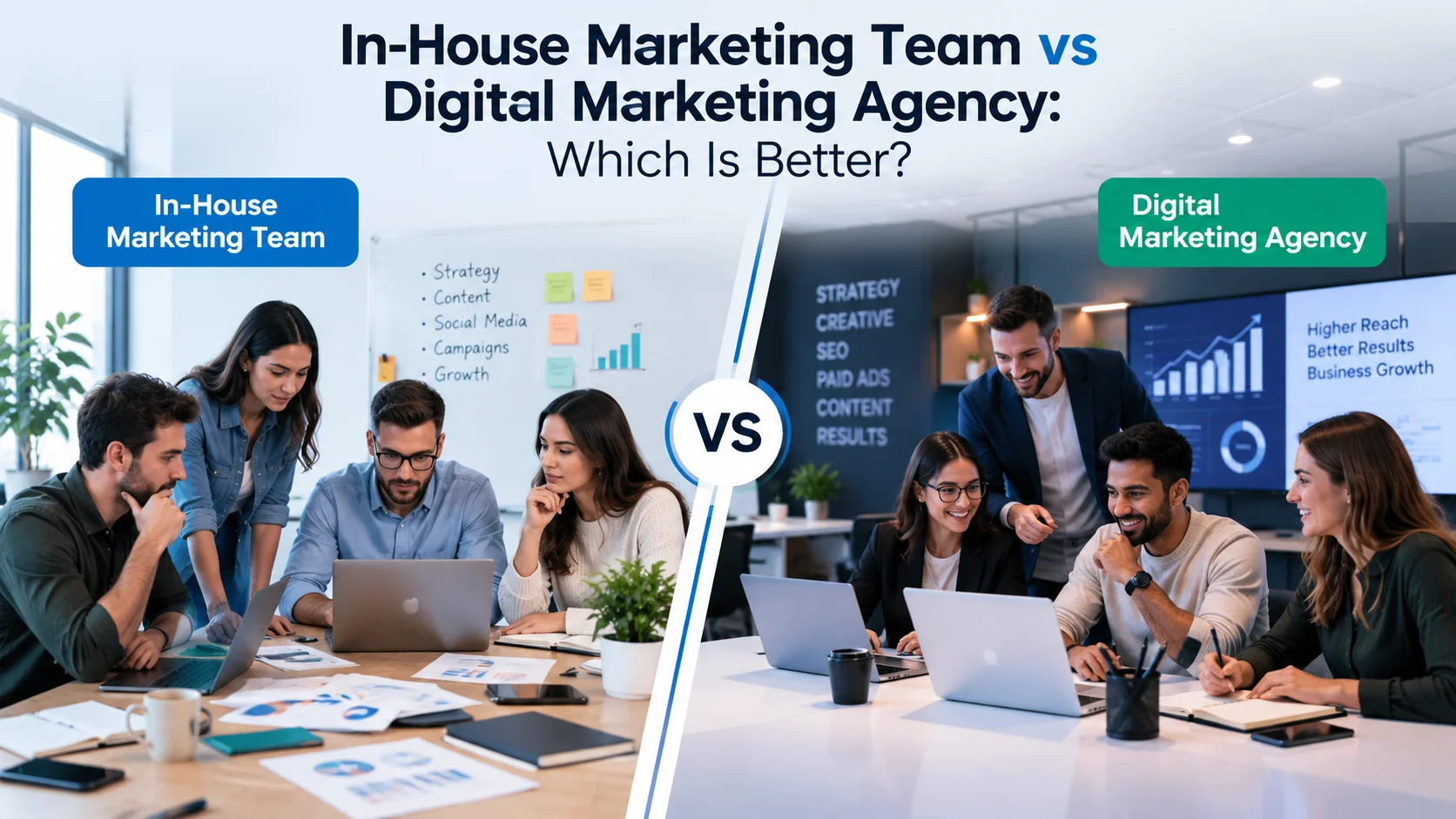
The in-house marketing vs agency decision often comes up when a business reaches the point where marketing needs more time, skills, or structure. Building an internal team gives you people who work closely with the business every day. An agency gives you access to outside specialists without hiring every role yourself. The better choice depends on what your business actually needs. Budget matters, but so do control, available skills, workload, speed, and how quickly your marketing needs may change.
In this guide, we’ll compare an in-house marketing team vs agency across expertise, costs, control, flexibility, scalability, and long-term fit. We’ll also look at when outsourcing makes sense and when a mix of internal and external support may work better.
In-House Marketing vs Agency: What’s the Difference?
An in-house marketing team consists of employees who work directly for your company. Their attention stays on your brand, products, customers, and internal goals. A digital marketing agency is an outside team hired to handle specific marketing services or provide broader support. Depending on the agency, this may include SEO, PPC, content, Local SEO, analytics, social media, and other digital channels.
The main difference in a digital marketing agency vs in-house setup is how the business gets the people and skills it needs. In-house marketing requires you to recruit and manage those people yourself. With an agency, the specialists already exist outside the business and are brought in through an agreed scope.
In-House Marketing vs Agency: Quick Comparison
This marketing team comparison gives you a quick view of the main differences before we look at each option in more detail.
| Factor | In-House Marketing Team | Digital Marketing Agency |
| Expertise | Depends on the people you hire | Access to several specialists |
| Cost level | Usually higher fixed cost | Usually more flexible based on scope |
| Control | High day-to-day control | Shared with an outside partner |
| Brand knowledge | Usually develops quickly | Builds over time |
| Communication | Direct and internal | Usually through an account or project lead |
| Scalability | Requires hiring or training | Often easier to expand |
| Tools | Purchased and managed internally | Often used as part of agency operations |
| Speed | Hiring can take time | Existing team may start sooner |
| Flexibility | Limited by current staff capacity | Scope can often be adjusted |
| Best fit | Businesses needing constant internal support | Businesses needing specialist or multi-channel help |
Choosing between a marketing agency or in-house team becomes easier once you look at how these differences affect the way your business actually operates.
Pros and Cons of an In-House Marketing Team

An internal marketing team can become closely connected with the business. That makes it useful when marketing depends on detailed brand knowledge, frequent internal discussions, and quick access to other departments. The trade-off is that building a capable team takes time, money, and ongoing management.
More Control
With an internal team, priorities can be changed directly. You decide what gets worked on, when it needs to happen, and who is responsible. That level of control is useful when marketing is closely tied to daily business decisions.
Strong Brand Knowledge
People who work inside the company spend more time around the product, customers, sales process, and internal teams. Over time, that usually gives them a strong understanding of the brand and how it should communicate.
Faster Communication
Internal marketers can speak directly with sales, leadership, customer service, product teams, or other departments. There are fewer layers between a question and an answer, which can make everyday coordination easier.
Higher Team Costs
The cost of an in-house marketing team goes beyond monthly salaries. A business may also need to cover recruitment, employee benefits, software, equipment, training, and additional hires. If your strategy requires several specialist roles, the fixed cost can rise quickly.
Limited Skill Range
A small team cannot realistically be highly skilled in every part of digital marketing. One person may understand SEO well but have limited experience with PPC. Another may be strong in content but not analytics or conversion work. As your marketing becomes more complex, those gaps become harder to ignore.
Slower to Scale
Adding capacity usually means hiring another employee, training someone internally, or using a contractor. That takes time. If the business suddenly needs a new skill, an internal team may not be able to add it immediately.
Pros and Cons of a Digital Marketing Agency
The benefits of a digital marketing agency are usually most noticeable when a business needs several skills but does not want to build a large internal department. The compromise is that an outside team will not have the same day-to-day access or direct control as your employees.
Specialist Expertise
Agencies often have people focused on different areas of marketing. Instead of asking one marketer to handle SEO, paid ads, content, reporting, and Local SEO, a business may be able to use specialists for each area when needed.
Easy to Scale
Agency support can often grow with the workload. You may start with one service and add another when priorities change. This can be simpler than recruiting a new employee every time your strategy expands.
Wider Experience
Agency teams usually work across different businesses, websites, campaigns, and marketing problems. That exposure can give them a broader view of what works, what tends to fail, and where common problems appear.
Access to More Tools
Digital marketing often depends on tools for research, reporting, analytics, advertising, tracking, and competitor analysis. An agency may already use many of these platforms as part of its normal work, reducing the need for the client to build its own full tool stack.
Less Daily Control
An agency is not sitting inside the business. You will usually work through an agreed scope, communication process, and reporting schedule. That means you may not have the same immediate access you would have with an internal employee.
Agency Fees and Contracts
Agency costs may include monthly retainers, project fees, or service-specific charges. Contracts can also limit how quickly scope changes. When considering the pros and cons of a marketing agency, look closely at what is included before comparing prices.
In-House Team vs Agency: Which Costs More?
Cost is one of the most important parts of the decision, but it is also easy to compare incorrectly. A single employee salary should not be compared directly with an agency fee if the agency provides several different skills. The better comparison is the total cost required to get the marketing capability your business needs.
Cost of an In-House Marketing Team
An in-house setup creates a more fixed cost structure. The business may need to pay for salaries, benefits, recruitment, training, software, equipment, and management time. If the team needs separate people for SEO, PPC, content, design, analytics, or other areas, each new role adds another ongoing cost. This means the cost of an in-house marketing team is usually lower when the team is small and the marketing needs are narrow. It becomes much higher as more specialist roles are added.
Cost of Working With a Marketing Agency
Agency costs depend mainly on the scope. A business using one service may have a much smaller commitment than a company outsourcing SEO, paid advertising, content, reporting, and several other channels.
Agency costs are usually more variable than internal employment costs because the business can often increase or reduce the scope when needs change.
| Cost Area | In-House Marketing Team | Digital Marketing Agency |
| Estimated cost level | High fixed cost as roles are added | Medium to high depending on scope |
| Salaries | Required | Not required |
| Employee benefits | Usually required | Not required |
| Recruitment | Managed internally | Agency handles its own hiring |
| Training | Business responsibility | Usually handled by agency |
| Tools and software | Usually purchased internally | Often part of agency operations |
| Adding new skills | May require another hire | May be added by increasing scope |
| Cost flexibility | Lower | Usually higher |
Neither option is automatically cheaper. A business with enough work to keep several marketers busy may justify an internal team. A company that needs several skills but not several full-time employees may get better value from agency support.
When Is an In-House Team a Better Fit?
An internal team often works best when marketing needs to stay very close to the business.
For example, some companies need marketers working with sales or product teams every day. Others have complex products, detailed approval processes, or a brand that takes time to understand properly.
An in-house setup can also make sense when there is enough ongoing work to support full-time roles. If your marketing team will be busy every day and the business has the budget to build the required skill set, the higher fixed cost may be worthwhile. Companies that want direct control over priorities and quick internal access may also prefer keeping more of the work in-house.
When Should You Hire a Marketing Agency?
A marketing agency becomes more useful when the business needs expertise or capacity that is difficult to build internally. You may need SEO, PPC, content, reporting, or another specialist skill, but not enough of each one to justify several full-time hires. An agency can fill those gaps without requiring you to build an entire department. Businesses also outsource digital marketing when they need to move faster. An existing agency team may be able to start specialist work sooner than a business can recruit and onboard a new employee. The outsourced marketing vs in-house choice therefore often comes down to how much expertise you need and whether you need it permanently or only as part of a wider marketing plan.
Which Is More Flexible: Agency or In-House?
Both models offer flexibility, but in different ways. An agency is often easier to scale. If you need additional PPC support, more content, or a new SEO project, the agency may already have someone who can handle it. An in-house team is usually more flexible with daily priorities. Employees are directly available and can often move between tasks quickly when something urgent comes up. In an agency vs internal marketing comparison, agencies generally provide more flexibility in skills and capacity. Internal teams usually provide more flexibility in daily control.
Can You Use Both an In-House Team and an Agency?
Yes. Many businesses do not need to choose one model exclusively. A company might keep a marketing manager internally while using an agency for specialist services. The internal person can manage priorities, approvals, brand direction, and communication, while the agency handles areas such as SEO, PPC, content, or Local SEO. This type of hybrid model can work well when the business wants internal control without having to hire every specialist role. The important part is defining responsibilities clearly. Both sides should know who owns strategy, approvals, execution, reporting, and final decisions.
How to Decide Between a Marketing Agency or In-House Team
There is no universal winner in the in-house marketing vs agency debate. The better option is the one that fits the way your business works and the kind of marketing support it actually needs.
Compare the Skills You Need
Start with the work, not the team structure. If your strategy needs SEO, PPC, content, analytics, design, Local SEO, and other skills, ask how many people you would realistically need to cover those areas well.
A broader skill requirement often makes an agency more practical. A smaller and more consistent workload may be easier to keep in-house.
Review Your Marketing Budget
Look at the full cost of each setup. Internal costs include more than salaries. Agency costs include more than the monthly fee. Compare what you will actually receive from each option and whether the business can support that cost over time. The cheapest option is not always the better value if it leaves important skills missing.
Decide How Much Control You Want
Some businesses want marketing decisions handled internally every day. Others are comfortable setting goals, approving strategy, and allowing an outside team to manage execution within that framework. If direct control matters most, in-house may suit you better. If access to wider expertise matters more, an agency may be the better trade-off.
Consider Speed and Scalability
Ask how quickly your marketing needs may change. If you expect to add channels, increase campaign volume, or enter new markets, an agency may make it easier to access more people without starting another hiring process. If the workload is predictable and you are building a permanent department, growing an internal team may be more suitable.
Think About Long-Term Needs
Do not base the decision only on what marketing looks like today. Think about what you may need next year. More campaigns? A larger content program? New locations? More reporting? A bigger paid media budget? The right setup should support that growth without forcing you to rebuild the marketing function every time priorities change.
How WaysProTech Can Support Your Marketing Team
Businesses do not always need to choose between a fully internal team and fully outsourced marketing. WaysProTech can support companies that want to outsource digital marketing as well as businesses that already have an internal team and need extra specialist support.
WaysProTech provides services such as:
- SEO Services in USA
- Local SEO Services in USA
- PPC Services in USA
- Web Development Services in USA
- Content Writing Services in USA
An internal team can continue managing brand knowledge, priorities, and business decisions while WaysProTech supports the areas where additional skills or capacity are needed.
The right arrangement depends on what your existing team already does well, where the gaps are, and which marketing activities need more support.
Frequently Asked Questions
Is an In-House Marketing Team Better Than an Agency?
Not always. An in-house team offers more direct control and stronger day-to-day brand knowledge, while an agency may provide a wider range of specialist skills.
Is a Digital Marketing Agency More Cost-Effective Than an In-House Team?
It can be. An agency may offer better value when a business needs several specialist skills but does not need each specialist as a full-time employee.
Can a Small Business Build an In-House Marketing Team?
Yes. A small business can build an internal team, but it should consider workload, salaries, tools, training, and whether each role has enough ongoing work.
Should I Outsource Digital Marketing if I Already Have an Internal Team?
Yes, if there are skill or capacity gaps. An agency can handle specialist work while the internal team keeps control of business priorities and brand direction.
Can a Digital Marketing Agency Work With an In-House Team?
Yes. A hybrid model lets the internal team manage strategy and business knowledge while the agency adds specialist expertise or execution support.
Which Option Gives a Business More Control Over Marketing?
An in-house team usually provides more direct control. An agency gives up some day-to-day oversight in exchange for broader expertise and easier access to additional resources.