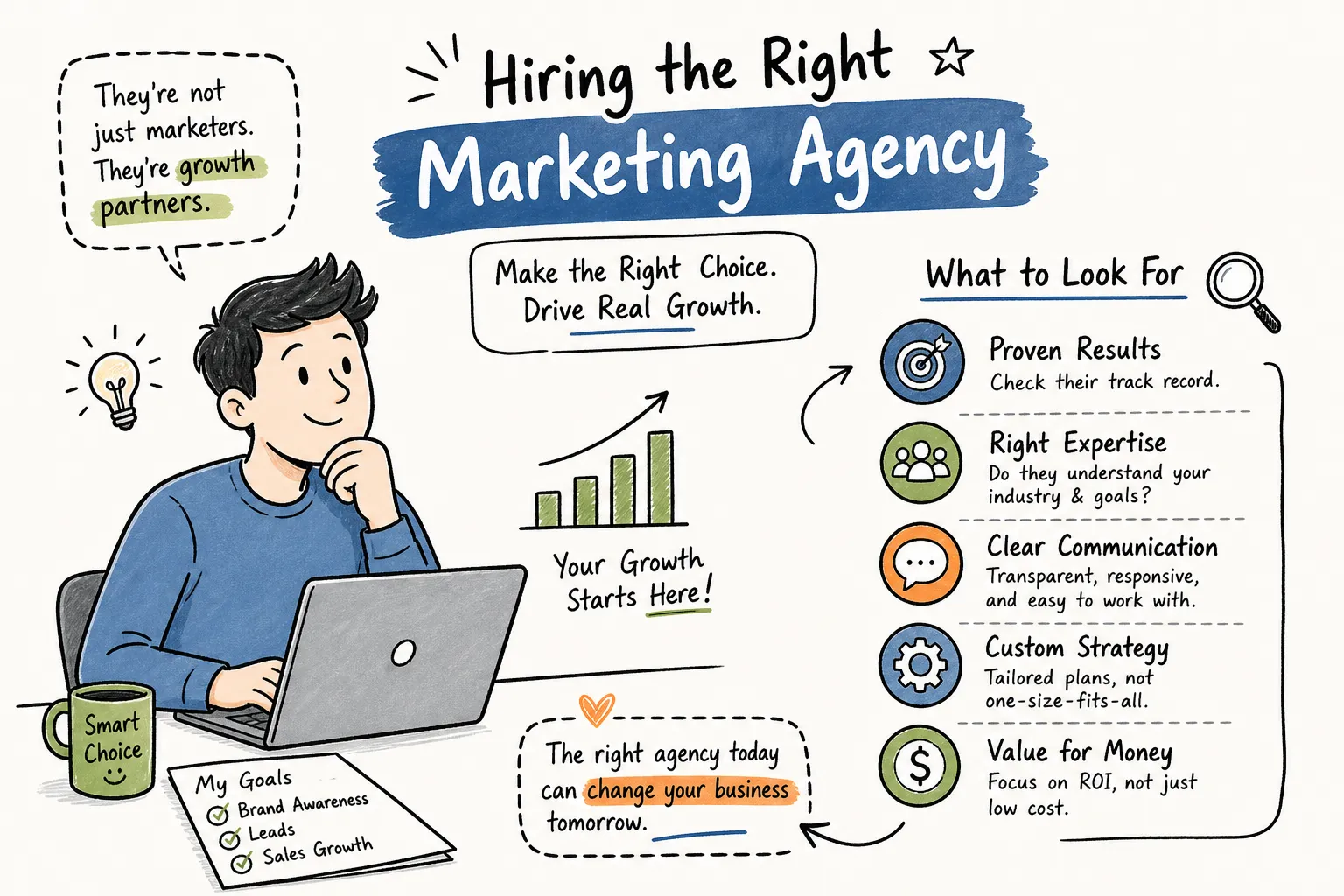
Choosing a marketing agency can shape how effectively your business attracts customers, uses its marketing budget, and measures growth. The difficult part is that many agencies appear similar on the surface. They may offer the same services but differ greatly in strategy, expertise, communication, and execution.
That makes agency selection about more than checking a service list or comparing monthly prices. You need to understand what your business actually needs, how an agency plans to address those needs, and whether its way of working fits your expectations. Knowing how to choose a digital marketing agency gives you a clearer way to compare options. Instead of relying on sales pitches, you can evaluate agencies based on relevant experience, strategic thinking, proof of work, transparency, and long-term fit.
Define Your Marketing Needs Before Choosing an Agency
A good digital marketing agency selection process starts before you contact any agency. If your goals are unclear, it becomes harder to judge whether the services being recommended are actually right for your business.
Start with four areas:
- Business problem: Identify what is holding growth back. This could be weak search visibility, poor lead quality, low website conversions, limited brand awareness, or inconsistent marketing.
- Marketing goals: Decide what needs to improve, such as qualified leads, sales, website traffic, local visibility, customer retention, or brand awareness.
- Services you may need: Consider whether your goals may involve SEO, PPC, content, social media, email marketing, website improvements, or a combination of channels.
- Budget and expectations: Decide what you can reasonably invest and what that budget needs to cover, including agency fees, advertising, creative work, software, and other campaign costs.
You do not need to arrive with a complete marketing plan. A capable agency should help turn your business goals into a clearer strategy. You should, however, know what problem you want marketing to solve.

What Type of Digital Marketing Agency Does Your Business Need?
Not every digital marketing agency is built for the same type of work. Some provide broad support across multiple channels, while others focus on a specific area. Understanding these differences makes it easier to narrow your options before you begin a detailed digital marketing agency evaluation.
Full-Service Digital Marketing Agency
A full-service agency offers several marketing capabilities within one team. Depending on the provider, these may include SEO, paid advertising, content, social media, email marketing, design, or website support. This model can make sense when several channels need to work together and you prefer dealing with one provider rather than coordinating multiple specialists.
Performance Marketing Agency
Performance marketing agencies focus heavily on measurable actions such as leads, sales, conversions, and customer acquisition. They are often considered when paid campaigns, conversion optimization, and measurable campaign performance are major priorities.
Creative Agency
Creative agencies generally focus on areas such as branding, messaging, visual identity, design, and campaign concepts. They may be a better match when the main challenge is how your business looks, communicates, or positions itself in the market.
Specialized Digital Marketing Agency
A specialized agency focuses deeply on one or a small number of disciplines, such as SEO, PPC, social media, email marketing, or content. This may work well when you already know which capability your business needs and want deeper expertise in that specific area.
How to Choose a Digital Marketing Agency
Once your goals are clear, you can start narrowing the market. When you choose a digital marketing agency, use consistent criteria rather than evaluating every provider differently.
Build a Goal-Fit Shortlist
Start with agencies whose capabilities match the problems you need to solve. If search visibility is the main challenge, relevant SEO expertise matters more than an impressive social media portfolio. If paid acquisition is your priority, experience managing performance campaigns becomes more important. A shortlist of relevant agencies is more useful than contacting a large number of providers with very different strengths.
Check Relevant Experience
Look at the problems an agency has solved, not only the industries listed on its website. Industry experience can be valuable because the agency may already understand the audience and buying cycle. However, experience solving a similar marketing challenge can be equally useful.
Verify Case Studies and Reviews
Look for evidence behind broad claims about growth or performance. Case studies should provide enough context to understand the challenge, the work performed, and the results being discussed. Reviews are also more useful when they describe the actual working relationship rather than simply giving praise. If important claims cannot be supported with examples, ask for clarification.
Meet the Team Behind Your Account
The people leading the sales process may not be the people doing the work. Find out who will manage your account, who develops the strategy, which specialists will be involved, and who reviews performance. This gives you a clearer picture of the expertise you are actually paying for.
Test Their Strategic Thinking
A strong agency should ask questions before recommending channels. It should want to understand your audience, business model, competition, existing performance, customer journey, and goals. Recommendations should come from that context. If the agency immediately recommends a fixed package without enough discovery, ask why those services are right for your business.
Inspect Reporting and KPIs
Ask how the agency will measure progress and why those metrics matter. Good reporting should tell you what happened, why it happened, what it means for the business, and what should happen next. A dashboard full of traffic, impressions, or clicks has limited value if those numbers are never connected to your actual goals.
Check Communication and Transparency
Pay attention to communication before you sign. Clear answers, realistic expectations, straightforward explanations, and openness about limitations are useful indicators. You should also understand how communication will work once the engagement begins and who your main point of contact will be.
Compare Scope, Pricing, and Terms
Two proposals with similar prices may include very different levels of work. Compare deliverables, reporting, meetings, campaign management, creative work, additional costs, contract length, cancellation terms, and ownership of important accounts or assets. Before you select a marketing agency, make sure you understand what is included as clearly as you understand the price.
Assess Long-Term Fit
Your marketing needs are likely to change. An agency that fits today should ideally be able to adapt as your priorities, channels, audiences, or budgets change. Consider whether the relationship could still work when your business requires something different six or twelve months from now. The best digital marketing agency for your business is not necessarily the biggest or cheapest. It is the one whose expertise, approach, and working style align with what your business actually needs.
What to Look for in a Digital Marketing Agency
Knowing what to look for in a digital marketing agency helps you separate meaningful indicators from polished sales material.
Business Understanding
The agency should make an effort to understand your customers, products or services, competitors, sales process, and wider goals. Without that context, technically correct marketing can still focus on the wrong problem.
Strategic Thinking
Look for reasoning behind recommendations. The agency should be able to explain why a channel or campaign deserves investment and how it supports the broader marketing objective.
Relevant Proof
Past work should show capability related to the services and problems you are hiring the agency to handle. A huge portfolio is less useful if none of it demonstrates relevant expertise.
Team Expertise
Understand which skills are available within the team and how specialists work together. This becomes especially important when your strategy involves several disciplines, such as SEO, paid media, content, design, and website improvements.
Data and Measurement
A good agency should know which metrics matter and what decisions those metrics support. Data should help identify opportunities, diagnose weak performance, test changes, and improve future campaigns.
Reporting Transparency
You should understand what work is being performed, what the results mean, and where your marketing budget is going. Also clarify ownership and access for advertising accounts, analytics, websites, campaign data, and creative assets before the relationship begins.
Cross-Channel Capability
Marketing channels often influence one another. Paid campaigns can bring traffic, but poor landing pages can reduce conversions. SEO can increase visibility, but unclear messaging can prevent visitors from taking action. An agency does not need to provide every possible service, but it should understand how its work connects with the rest of your marketing.
Communication Quality
Good communication is not about scheduling constant meetings. It means having clear points of contact, understandable reporting, realistic expectations, useful updates, and timely discussions when performance or priorities change.
How to Compare Digital Marketing Agencies
Once you have a shortlist, use the same criteria for each provider. A consistent comparison works as both a digital marketing agency evaluation framework and a practical digital marketing agency checklist before you make the final decision.
| Evaluation Area | What to Check |
| Experience | Relevant experience with similar goals or marketing challenges |
| Services | Whether the agency provides the capabilities you need |
| Strategy | How well its recommendations connect to business goals |
| Team | Who creates the strategy, manages the account, and performs the work |
| Proof | Case studies, reviews, references, and relevant examples |
| Reporting | Metrics used, reporting frequency, and quality of analysis |
| Communication | Responsiveness, clarity, and account management |
| Pricing | Fees, additional costs, and what is included |
| Contract | Duration, cancellation terms, ownership, and responsibilities |
| Long-term fit | Ability to adapt as your marketing needs change |
Do not automatically eliminate an agency because its proposal costs more. First determine whether you are comparing equivalent scope, expertise, and support.
Questions to Ask Before You Hire a Digital Marketing Agency
Before you hire a digital marketing agency, ask questions that reveal how the agency develops strategy, manages work, communicates, and responds when things do not go according to plan.
Questions You Need to Ask
- How will you build a strategy for my business?
- Which marketing channels do you recommend and why?
- Who will work on my account?
- How will you measure success?
- How often will you report and communicate?
- Will I have access to my marketing and advertising accounts?
- What is included in the pricing and contract?
- How do you handle campaigns that are not performing?
How Will You Build a Strategy for My Business?
The answer should start with your goals, audience, competition, existing performance, and available data. Be cautious if the strategy appears to be a standard package prepared before the agency understands your business.
Which Marketing Channels Do You Recommend and Why?
The agency should explain why each channel fits your objectives. A useful answer connects the recommended channel to customer behavior, business goals, and available resources.
Who Will Work on My Account?
You should know who manages the relationship, who makes strategic decisions, and which specialists perform the work. This also helps you understand how much direct access you will have to the people responsible for results.
How Will You Measure Success?
The answer should go beyond surface-level metrics. The agency should explain which KPIs matter for your goals and how those metrics will be used to judge progress.
How Often Will You Report and Communicate?
Clarify reporting frequency, review meetings, the main point of contact, and how urgent issues are handled. The communication model should fit the complexity of the work and your internal needs.
Will I Have Access to My Marketing and Advertising Accounts?
You should know who controls important accounts, data, and marketing assets. Clarify access and ownership before campaigns begin rather than after the relationship ends.
What Is Included in the Pricing and Contract?
The agency should clearly explain deliverables, management fees, advertising spend, additional costs, contract duration, and cancellation terms. You should be able to tell what is included and what would require an additional fee.
How Do You Handle Campaigns That Are Not Performing?
Marketing does not always produce the expected result immediately. A strong answer should explain how the agency diagnoses problems, tests alternatives, changes strategy, and communicates weak performance rather than simply continuing the same activity.
Red Flags When Choosing a Digital Marketing Agency
When choosing a marketing agency, look beyond obvious warning signs. Some problems only become clear when you examine how the agency sells, reports, and explains its work.
Big Promises Without Proof
Claims of guaranteed rankings, instant growth, or fixed results deserve scrutiny. Marketing performance depends on factors such as competition, budget, market demand, customer behavior, and the condition of your existing digital presence. An agency should be willing to explain uncertainty rather than promise an outcome it cannot fully control.
Copy-Paste Marketing Plans
Your customers, goals, market position, and website are different from another company’s. If every prospect receives essentially the same channel mix and campaign plan, the strategy may be designed around what the agency wants to sell rather than what your business needs.
Case Studies With Missing Context
Large percentages and impressive screenshots can look convincing without telling you much. Look for enough detail to understand the starting point, work performed, measurement period, and outcome. Missing context can make results appear more meaningful than they are.
Reports That Stop at Metrics
Reporting should lead to decisions. If an agency can show clicks, traffic, leads, or rankings but cannot explain what those numbers mean or what should change next, the reporting process may be more focused on activity than improvement.
Restricted Control of Your Accounts
Clarify access to advertising, analytics, and other marketing accounts before signing. Your business should not discover later that important data, campaign history, or digital assets are inaccessible without the agency.
Silence When Things Get Difficult
Good communication matters most when results are weaker than expected. An agency that avoids difficult conversations or delays explanations may make it harder to correct problems quickly.
Costs That Appear After Signing
Vague scopes often lead to unexpected charges. Make sure costs for advertising, creative work, tools, website changes, additional campaigns, and other extras are clear before the engagement begins.
Selling Before Listening
An agency should understand the problem before prescribing the solution. If the conversation moves directly into selling SEO, ads, social media, or another service without enough questions about your business, ask what evidence supports that recommendation.
Digital Marketing Agency vs Freelancer vs In-House Team
A digital marketing agency is only one way to manage marketing. Depending on your needs, a freelancer or an internal team may be a better option.
Because actual prices vary widely by country, experience, scope, and team size, the table uses relative estimated cost levels rather than unsupported fixed prices.
| Factor | Digital Marketing Agency | Freelancer | In-House Team |
| Expertise | Access to several specialists | Usually focused on one or a few skills | Depends on the people hired |
| Estimated cost level | Medium to high | Low to medium | High fixed cost for a full team |
| Scalability | Easier to add services or specialists | Limited by individual capacity | Usually requires additional hiring |
| Control | Shared with an external partner | Shared with an external specialist | Highest internal control |
| Communication | Usually through an account or project lead | Usually direct | Direct internal access |
| Strategic support | Can cover several marketing areas | Depends on the freelancer | Depends on internal seniority |
| Best fit | Businesses needing multiple skills or external expertise | Specific or clearly defined work | Businesses needing constant internal marketing support |
These options can also be combined. An internal marketing manager, for example, may work with an agency for specialist support while using freelancers for occasional projects.
How WaysPro TECH Supports Your Digital Marketing Goals
When choosing a digital marketing agency, the right fit depends on how well its services match your business goals. Businesses trying to find a digital marketing partner should look for one that can connect strategy, execution, and performance rather than offer services in isolation.
WaysPro TECH supports businesses through services such as:
- SEO Services in the USA.
- Local SEO Services in the USA.
- Review Management Services in the USA
- Content Writing Services in the USA
- PPC Services in the USA
The right service mix depends on your audience, current digital presence, and marketing priorities. By aligning these services with clear goals, businesses can build a more focused digital marketing strategy and review performance over time.
Frequently Asked Questions
What Should I Look for in a Digital Marketing Agency?
Look for relevant expertise, clear strategy, proven work, transparent reporting, strong communication, and an understanding of your business goals.
How Much Does It Cost to Hire a Digital Marketing Agency?
Costs depend on the services, scope, campaign size, and level of support required. Compare what each proposal includes rather than choosing based only on price.
Should I Choose a Full-Service or Specialized Marketing Agency?
It depends. A full-service agency may suit businesses needing several marketing services, while a specialized agency may be better for one specific area.
How Can I Evaluate a Digital Marketing Agency Before Hiring?
Review its experience, case studies, team expertise, strategy, reporting process, communication, pricing, and contract terms before making a decision.
Is a Digital Marketing Agency Better Than a Freelancer?
Not always. An agency usually offers broader expertise and scalability, while a freelancer may be better for specific or clearly defined work.