The ad that appears right after you search for a new laptop. The product recommendation that fills your cart.
The email that lands two days after you abandon it. AI in modern marketing powers all of it, deciding what you see and when you see it.
Industry surveys report that a large majority of marketing professionals now use some form of generative or predictive AI in their daily work.
In plain language, AI in marketing is software that learns from customer data to make decisions and automate tasks that once required a person. It segments audiences, drafts copy, predicts purchases, and adjusts ad spend.
The result: campaigns move faster, personalization happens at the individual level, and teams get hours back every week.
This guide covers what AI means for marketing today, how teams use it in digital marketing, where it beats traditional approaches and where it falls short, the real challenges you’ll face, and where the field is heading next. The thread running through all of it: AI amplifies marketers it doesn’t replace their judgment.
| Key takeaways 1. AI in marketing is any software that learns from data and automates tasks chatbots, predictive analytics, generative content, and automated ad targeting all count. 2. AI wins on scale: processing large datasets, personalizing per visitor, and running continuous tests. 3. Humans still win on brand strategy, creative judgment, cultural nuance, and accountability. 4. The biggest near-term shift is autonomous agents that execute campaigns end to end, with a human setting goals and guardrails. |
Why AI in Modern Marketing Matters
AI has moved from an experiment to a core part of marketing operations. Most marketing organizations now run at least one AI tool as part of daily work.
Content teams commonly report cutting production time roughly in half after adopting AI writing assistants, and even small businesses with no dedicated data team use AI features already built into their email, CRM, and social platforms.
The thread running through all of these examples is simple: AI uses data to make faster, better-informed decisions than guesswork alone. But there’s an important caveat these tools work because skilled people put them to work.
A chatbot can’t set brand strategy. A predictive model can’t decide whether a campaign message is culturally appropriate.
AI amplifies a good marketer’s capabilities; it doesn’t make up for the absence of one.
What AI in marketing really means
AI in marketing covers any software that learns from data and automates tasks that used to require human effort. The learning part is what separates it from traditional automation.
A standard autoresponder follows a fixed rule every time. An AI tool studies past behavior and adjusts its response on its own.
Two examples make this concrete. m.
understands the question, checks available information, and replies without anyone on shift. An ad platform decides who sees a special offer by weighing browsing history, past purchases, and demographic signals.
Neither task is new AI just removes the manual bottleneck.
Why adoption has grown so fast
Practical wins are driving adoption, not hype. HubSpot’s annual State of Marketing research has found that a majority of marketers now use AI in daily work, and that a large share of content creators rely on it to save meaningful time each week.
Those savings show up in day-to-day work: a social media manager who used to spend an afternoon writing captions can generate a week of ideas in an hour; an e-commerce brand that once sorted customers into a few broad segments can now personalize its homepage for every visitor.
Choosing the right software still matters. Some AI tools for digital marketing are built for enterprise teams with large budgets, while others serve solo operators.
The common denominator is that the best tool is the one your team will actually use consistently not the one with the longest feature list.
How Marketers Are Using AI in Digital Marketing Today
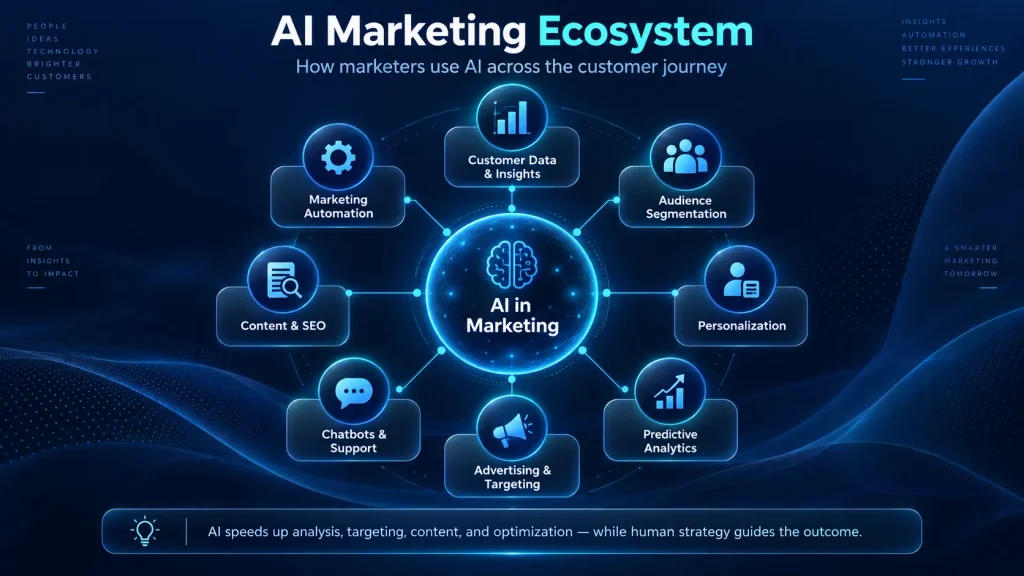
The use cases fall into a few broad categories. Each solves a different problem, but they all build on the same foundation: customer data.
Customer data analysis and audience insights
AI processes customer data at a speed no human team can match. An analyst might spend weeks digging through purchase histories, support tickets, and website behavior; an AI model can work through the same data in hours and surface patterns the analyst might never notice for example, a product bundle that sells best among a specific age group who also browsed a particular category.
These insights feed everything else, from campaign messaging to inventory decisions.
Customer segmentation and personalization
” AI builds granular segments from hundreds of signals and tailors content in real time. A retail homepage can swap its banner depending on whether a visitor is a first-time shopper, a repeat buyer with a category preference, or someone who abandoned a cart two days ago.
Personalization at this scale is only practical with AI a human team can’t hand-write a thousand homepage variations, and customers now expect this level of relevance.
Predictive analytics and better marketing decisions
Predictive analytics uses past behavior to forecast what a customer does next, usually framed as a probability a customer might be estimated as 70% likely to churn within a month, or 45% likely to buy a specific product if offered a discount.
These models help marketers choose their next action: prioritizing subscribers most likely to churn for a retention offer, or shifting budget toward the channels showing the strongest signals. As third-party cookies phase out, predictive models increasingly rely on first-party data email addresses, purchase history, loyalty activity, and on-site behavior which tends to be more reliable and doesn’t depend on cross-site tracking.
Advertising and audience targeting
AI now runs a large share of digital ad spend. Programmatic platforms use it to bid on placements in real time, build lookalike audiences, and test creative variations automatically.
In a Performance Max or Advantage+ style campaign, the marketer sets a goal and supplies creative, budget, and audience signals; the platform decides where to show ads, how much to bid, and which creative combination performs best, adjusting continuously as it collects results.
The trade-off is real: less manual control in exchange for efficiency and reach. Marketers can’t choose exactly which site shows their ad in a Performance Max campaign they gain scale and lower cost per result but give up precision.
This works well for some goals and poorly for others, and it’s worth deciding case by case.
Chatbots and customer engagement
Conversational AI handles routine questions, qualifies leads, and provides support around the clock. A store assistant can answer shipping questions, check order status, and suggest products mid-conversation.
The value goes beyond saving support time a chatbot captures leads that would otherwise go cold, especially at night or on weekends, and response speed is one of the biggest drivers of lead quality.
Chatbots do have limits. They handle common questions and straightforward transactions well; complex issues still need a human agent, and customers can tell when a bot is out of its depth.
The best setup uses AI for the first response and hands off to a person when the conversation goes beyond what the bot can handle.
Content generation, SEO, and the automation layer
AI content creation has become a standard part of the marketing workflow drafting social captions, blog outlines, subject lines, product descriptions, and ad copy in seconds. The best results come from treating AI output as a first draft, then editing it to match brand voice.
AI has also changed SEO: it helps with keyword research, content clustering, on-page optimization, and technical audits, and can flag topical gaps across a site. For a deeper look, see our guide to AI SEO.
Marketing automation rounds out the layer. AI-driven workflows handle email sequences, lead scoring, and campaign triggers without manual intervention a lead who downloads a guide can automatically enter a nurture sequence and receive follow-ups based on their behavior.
Across all three areas, the same rule applies: AI output needs human review before it goes live. Generative tools can produce confident but wrong content, and automation can send the wrong message at the wrong time.
The model drafts; the human approves.
AI Marketing vs. Traditional Marketing: Where Each Wins
The most useful question isn’t which approach is better it’s where each one actually performs better, because both have strengths the other lacks.
What AI marketing does better
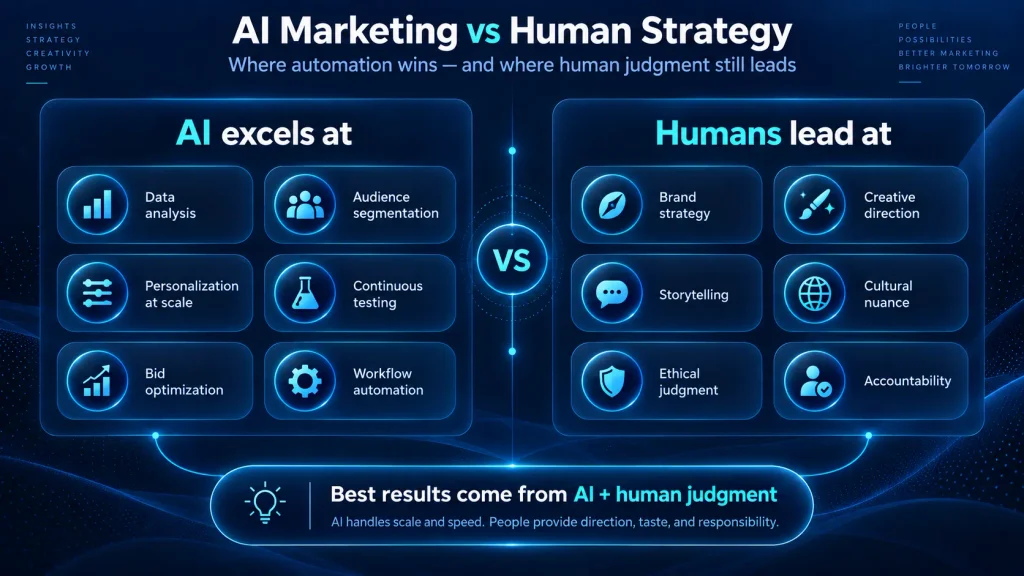
AI wins on jobs that require processing large datasets, personalizing at scale, and running continuous tests. It analyzes behavior across millions of customers without fatigue, personalizes email, web, and ad content per individual, and automates repetitive tasks like A/B testing, reporting, and bid management.
Dynamic creative optimization is a strong example: the AI tests combinations of images, headlines, and calls to action across audiences, then shifts spend to the best performers. A human team might run one or two tests at a time; the AI runs dozens and keeps learning.
A chatbot that never sleeps works the same way answering questions and moving leads through the funnel at any hour, at an uptime no human support team can match. These strengths are real, but they’re not universal.
AI handles specific kinds of work exceptionally well and other kinds poorly.
Where traditional marketing and human judgment still win
People still beat machines at brand strategy, creative direction, storytelling, and cultural nuance. A brand voice built on humor or local context will sound flat coming from a generic model, and a campaign built around a cultural moment needs someone who understands that moment from the inside.
AI can draft and suggest, but it can’t judge tone, taste, or fit.
Consider a brand known for wit and playful irreverence. An AI draft might produce correct but lifeless copy.
A skilled copywriter recognizes that a joke lands differently across regions, that a phrase can read as offensive in one market and charming in another, and that timing matters judgments that aren’t algorithmic. The strongest teams blend both: AI for the heavy lifting (data analysis, segmentation, testing, first drafts), and human strategy and judgment for the parts that actually move the brand forward.
The Real Challenges and Limitations of AI in Marketing
Every tool has drawbacks, and AI marketing tools are no exception. These challenges matter because they show why human oversight isn’t optional.
Data quality, privacy, and algorithmic bias
The garbage-in, garbage-out problem is the most fundamental issue: a model is only as good as the data it learns from. Poorly maintained customer records lead to bad targeting; missing demographic data leads to wrong recommendations; duplicate entries and outdated fields degrade every output downstream.
Privacy rules add another layer. Regulations such as the GDPR and the EU AI Act define what marketers can do with customer data, and the AI Act’s transparency requirements for AI-generated content are being phased in with substantial potential penalties for non-compliance check the current official guidance for exact dates and figures, since implementation timelines have shifted more than once.
Most marketing AI use cases fall into lower-risk categories, but that doesn’t remove the need for clear consent and documentation.
Bias is a subtler problem. If a model learns from historical data that reflects past discrimination or skewed targeting, it reproduces those patterns a job-ad campaign might reach one demographic group more than another because the training data carried that bias.
Regular data audits, diverse training data, and frequent fairness checks are practical safeguards.
AI hallucinations and the sameness trap
Hallucination means the model confidently states something false. A chatbot might invent a discount code; a content tool might cite a URL that leads nowhere.
This isn’t rare every AI output should be treated as a draft until verified.
A second issue is brand homogenization: when thousands of brands use the same tools with similar prompts, their copy starts to sound identical, and search engines have increasingly penalized unverified, low-effort AI content. The fixes are straightforward fact-check every output before publishing, maintain clear brand guidelines, and apply a human edit that injects real personality.
Over-automation and the lost human touch
Automation works until it becomes the point. A brand that automates every email, post, and support reply can feel tone-deaf, especially when a customer’s problem doesn’t fit the automated framework.
There’s also a skill risk: junior marketers who lean on AI for everything may never learn to write a brief, analyze results, or handle a difficult client and when the tool fails, they have no fallback. The guiding principle: automate the repetitive work, keep a human on strategic and high-stakes decisions.
The Future of AI in Marketing and the Marketer’s Role
The direction of travel is clear: AI is getting more capable, more integrated, and more autonomous, and the marketer’s role is shifting along with it.
Trends shaping the future of AI in marketing
Autonomous agents are the biggest shift on the horizon systems that don’t just suggest actions but execute entire workflows: monitoring performance, adjusting budgets, writing new ad variations, and pausing underperformers without a human clicking a button. Analysts such as Gartner have projected a steady rise in the share of routine marketing decisions made autonomously through commercial generative AI over the next few years; treat the specific percentages as directional forecasts rather than fixed facts, since these estimates get revised as the technology matures.
Generative AI is also moving beyond text. Tools that create presenter-led, multilingual video are cutting localized ad production from weeks to days.
Predictive analytics is shifting from monthly reports to real-time decisions instead of reviewing last month’s churn data, teams increasingly act on live signals.
Why human strategy and oversight still matter
AI can identify patterns, generate options, and automate execution. It can’t decide what a brand should stand for, whether a message is ethical, or whether a short-term gain is worth a long-term reputation cost and it can’t take responsibility.
When an automated campaign goes wrong, a person has to catch it, fix it, and own the outcome. The skills that matter are shifting accordingly: strategy, creativity, ethics, and oversight are becoming the core of the marketing job, and roles focused on AI workflow governance are already emerging.
The winning approach is consistent: AI handles the heavy lifting while humans provide direction, taste, and accountability. That’s not a compromise it’s the point.

Frequently Asked Questions
What is artificial intelligence in marketing?
AI in marketing is software that learns from data and automates tasks that once required human effort chatbots, recommendation engines, predictive analytics, generative content tools, and automated ad targeting all fall under this umbrella. The common goal is using data to make faster, better marketing decisions.
How is AI used in digital marketing?
Teams use AI for customer data analysis, audience segmentation, personalization, predictive analytics, ad targeting, chatbots, content generation, SEO, and workflow automation. Each application solves a different problem, but all depend on the same foundation of customer data.
Can AI replace marketers?
No. AI handles analysis, research, personalization, automation, and optimization, but it can’t provide brand strategy, creative direction, cultural judgment, or accountability.
The marketers who thrive will be the ones who use AI well not the ones who ignore it.
What is the future of AI in marketing?
The near future includes autonomous agents that execute campaigns with minimal human input, generative tools producing video and voice at scale, and predictive analytics running in real time. As these tools improve, marketers will focus more on strategy, ethics, creativity, and oversight.
Conclusion
AI in modern marketing is a practical tool for analyzing data, personalizing experiences, and automating busywork and it works best paired with human strategy, creativity, and judgment. The teams that get this right won’t be the ones with the most advanced technology; they’ll be the ones that use AI to handle the volume while people make the calls that define the brand.
If your team is evaluating how AI should fit into your broader marketing strategy, WaysProTech can help connect tool selection with a practical digital marketing plan.